The Strategic Website Redesign: Planning for 2027 and Beyond
Why most website redesigns fail to deliver ROI, and how to build a data-backed roadmap that prioritizes user intent and agent-readiness.
Free tool
Grade your website before you keep reading
Most readers want a quick benchmark first. Start with the free Website Grader, then come back to this article with a clearer sense of what to fix.
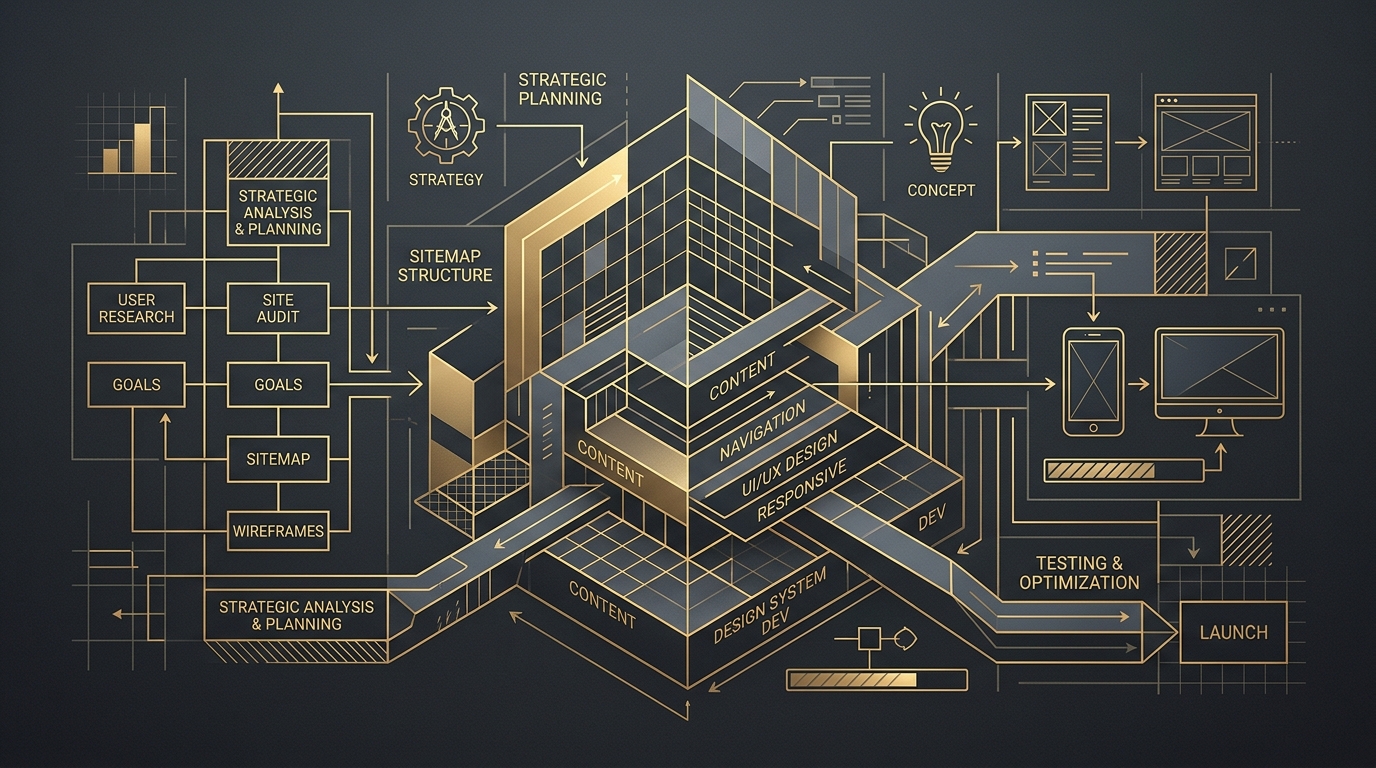
By the time you finish reading this article, several thousand businesses will have started a website redesign process. Statistically, 60% of them will miss their launch date, and 40% will fail to see a meaningful increase in conversion rates.
Why? Because most redesigns are treated as "paint jobs" rather than "structural engineering." In 2026, a website is no longer just a digital brochure; it is a high-performance engine that must cater to two distinct audiences: human users and AI agents.
If you are planning a redesign for the coming year, here is how to move from a "vibes-based" approach to a strategic roadmap that guarantees ROI.
1. Audit Your Existing 'Intent Gaps'
Before looking at a single Figma file, look at your analytics. But don't just look at page views. Look for **Intent Gaps**.
* **Where do users drop off?** Is it because of slow load times (Technical Gap) or because the copy doesn't answer their specific question (Cognitive Gap)?
* **What are they searching for on-site?** Your internal search bar is a goldmine of unfulfilled user needs. If they are searching for "pricing" on your "features" page, your navigation is failing.
2. Design for the 'Agent-First' Future
We are entering the era of the **Agentic Web**. Increasingly, your website will be "browsed" by AI agents (like Perplexity, OpenAI Search, or personal AI assistants) before a human ever sees a pixel.
* **Schema is your Skeleton:** During your redesign, prioritize Schema.org markup. This allows AI to understand your products, reviews, and FAQs without "guessing."
* **LLMS.txt Integration:** Ensure your new site structure includes a `/llms.txt` file—the robots.txt of the AI era—to help Large Language Models index your site's most important technical documentation or product features accurately.
3. The 'Affirmative Friction' Paradox
Counter-intuitively, the goal of a 2027 redesign isn't always "zero friction." In high-consideration industries (Consulting, Enterprise SaaS, Real Estate), too little friction leads to low-quality leads.
* **Strategic Interventions:** Use your redesign to introduce "Affirmative Friction"—brief, helpful moments that ask the user for clarity (e.g., "Which industry are you in?") to personalize the rest of their journey. This increases trust and lead quality simultaneously.
4. Performance as a Design Constraint
In 2026, speed is a functional requirement, not a technical optimization.
* **Budgeting for Speed:** Establish a "Performance Budget" at the start of the design phase. If a new high-resolution video background pushes your LCP (Largest Contentful Paint) over 1.2 seconds, it doesn't make the cut.
5. The Living Redesign
The biggest mistake in website planning is the "Big Bang" launch.
* **Iterative Rollouts:** Plan for a Modular Redesign. Update the high-traffic landing pages first. Test the new UX on a subset of users. Gather data, refine, and then roll out the rest of the site. This reduces risk and allows for real-world feedback to shape the final product.
Summary
A successful redesign in 2027 is about **Alignment**. Aligning your technical stack with AI search requirements, aligning your UX with actual human intent, and aligning your business goals with performance metrics.
Stop guessing and start building. SiteInsight AI specializes in data-driven website strategy and performance-first redesigns.
Turn this article into a real benchmark
Start with the free Website Grader for an instant score, then move to the full AI scan when you want page-level recommendations.
Open the Free Website Grader →