AI-Driven A/B Testing: How to Optimize Your Website in Real-Time
Discover how AI-driven A/B testing is revolutionizing conversion rate optimization by enabling real-time website adjustments and hyper-personalization.
Free tool
Grade your website before you keep reading
Most readers want a quick benchmark first. Start with the free Website Grader, then come back to this article with a clearer sense of what to fix.
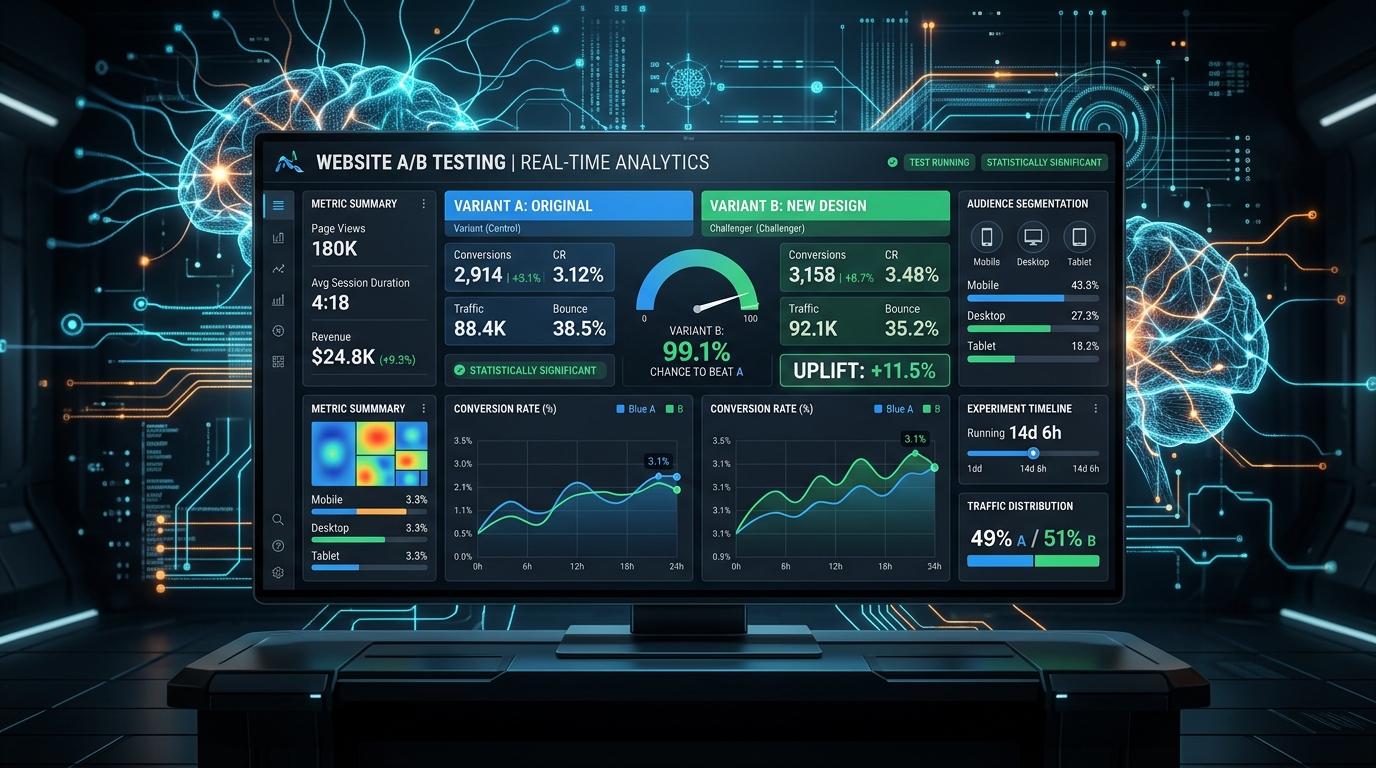
The old way of A/B testing is dying. You know the drill: pick a variable, split your traffic 50/50, wait two weeks for "statistical significance," and then realize the winner is barely better than the original. In the fast-moving world of 2026, waiting weeks for a result is a luxury most businesses can't afford.
Enter AI-driven A/B testing. It’s not just a faster version of the old method—it’s a completely different approach to how we optimize websites.
The end of the "Winner Takes All" model
Traditional A/B testing is binary. Version A wins, and Version B is discarded. But what if Version B actually worked better for 20% of your audience? In a traditional test, you’d never know. You’d just throw that 20% conversion boost in the trash.
AI doesn't do "winner takes all." Modern platforms use multi-armed bandit (MAB) algorithms. Instead of a static split, the AI constantly adjusts traffic based on real-time performance. If it notices that users coming from mobile devices are responding better to the blue button, it starts showing that button to more mobile users instantly.
Real-time optimization: No more waiting
The biggest hurdle in CRO has always been sample size. If you don't have millions of visitors, a standard test takes forever. AI-driven testing changes the math. Because the system is learning as it goes, it can detect patterns far earlier than a human looking at a spreadsheet.
By analyzing hundreds of data points—everything from scroll depth to cursor movement—the AI can predict which version will perform better before the "traditional" significance threshold is even met. This means you can roll out optimizations in hours, not weeks.
Hyper-personalization at scale
We’re moving beyond simple A/B tests (one variable) and even multivariate tests (a few variables). AI allows for "Experience Testing."
Imagine a landing page that reconfigures itself for every visitor. For a returning customer, the AI might emphasize loyalty rewards. For a first-time visitor coming from a high-intent search query, it might prioritize a deep-dive technical case study. This isn't just A/B testing anymore; it's real-time personalization.
The technical shift: From static to dynamic
To make this work, your tech stack needs to be ready. Traditional A/B testing tools often cause "flicker"—that annoying moment where the original page loads for a split second before the test version appears.
2026's AI tools integrate directly with your CMS or edge workers. They happen at the server level, meaning the user never sees a glitch. The experience is seamless, which is crucial for maintaining trust and keeping load times low.
Is the human optimizer obsolete?
I get asked this a lot. The answer is a loud "No."
AI is incredible at *refining*, but it’s terrible at *inventing*. An AI can tell you which of three headlines works best, but it can't understand your brand’s "soul" or come up with a radical new value proposition. Your job has shifted from managing the test to managing the strategy. You provide the creative hypotheses; the AI handles the brutal, data-heavy execution.
How to get started
If you’re still running static 50/50 tests, you're leaving money on the table. Start looking into tools that offer:
The goal isn't just to find a "winning" version of your site. The goal is to ensure every single visitor gets the version that’s right for them, right now.
Turn this article into a real benchmark
Start with the free Website Grader for an instant score, then move to the full AI scan when you want page-level recommendations.
Open the Free Website Grader →