Predictive CRO: testing landing pages before real users ever see them
There is a painful pattern in digital marketing that almost every team knows.
Free tool
Grade your website before you keep reading
Most readers want a quick benchmark first. Start with the free Website Grader, then come back to this article with a clearer sense of what to fix.
# Predictive CRO: testing landing pages before real users ever see them
There is a painful pattern in digital marketing that almost every team knows.
A landing page gets designed, reviewed, tweaked, rewritten, approved, and launched with a decent media budget behind it. Then the real traffic arrives and exposes something embarrassingly basic. The call to action blends into the layout on mobile. The trust signals sit too far down the page. The form feels annoying. The offer is not clear fast enough.
By the time the problem is obvious, the ad spend is already burning.
That is why predictive CRO matters.
Instead of waiting for live users to reveal the weak spots, predictive CRO tries to surface likely friction before launch. It gives teams a chance to fix obvious issues while changes are still cheap.
What synthetic user testing actually means
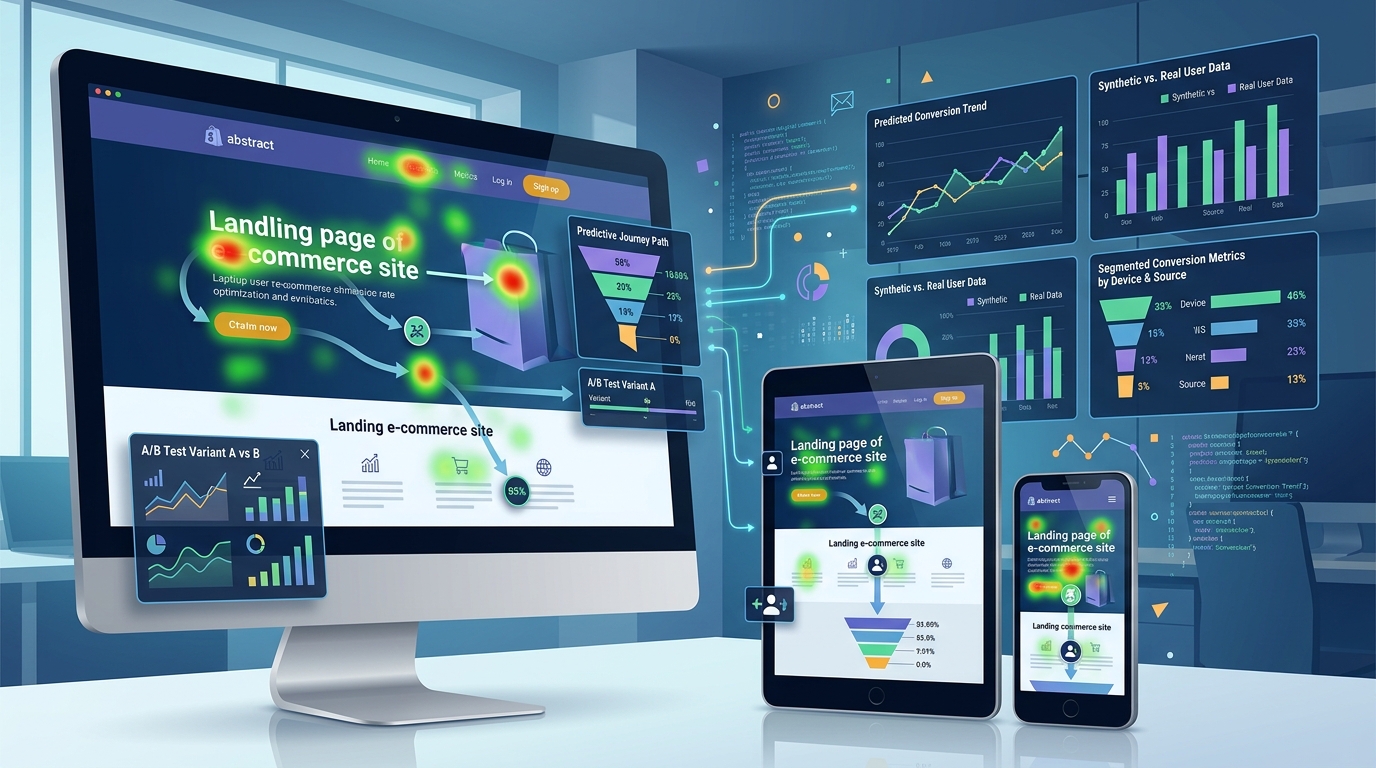
Synthetic user testing uses automated models to move through a page the way a person might. This is more useful than a basic QA check because the goal is not just to confirm that a button works. The goal is to see whether the page makes sense.
A good test setup imitates different user mindsets.
One visitor may be skeptical and looking for reassurance. Another may be in a hurry and ready to buy if nothing slows them down. Another might be comparing options carefully and looking for proof before committing. The page may technically function for all three, but still confuse or lose two of them.
That distinction matters. Conversion problems are often not technical failures. They are hesitation failures.
Why standard A/B testing is not enough on its own
A/B testing still has a place. It is useful when you already have traffic and want to compare two live options.
But it is reactive by nature.
You launch version A and version B, then wait for enough data to tell you which one performs better. Sometimes that works well. Sometimes it just tells you which version is slightly less confusing than the other. Either way, you are learning after the page has already gone live.
Predictive CRO shifts some of that learning earlier.
If your synthetic tests show repeated drop-off before users reach your form, your messaging may be unclear. If tests consistently stall around shipping, pricing, or trust signals, that is a clue worth acting on before you buy more clicks.
The point is not to replace real-world data. It is to stop making paid traffic do all the diagnostic work.
What predictive CRO is good at catching
In practice, predictive CRO is especially useful for a few common problems:
Weak visual hierarchy
If users cannot tell what matters first, the page feels harder than it should. Synthetic testing can flag pages where the call to action is visually weak, buried under too much copy, or competing with secondary elements.
Missing reassurance
Many landing pages ask for trust too early. They want the click before they have answered basic questions. Where is the proof? What happens next? Can I return this? Is this business credible? Pages often underperform because they rush past those concerns.
Mobile friction
A page that looks fine on desktop may be clumsy on a phone. Buttons may sit too close together. Checkout steps may feel longer than they look in a design file. Text may turn into a wall. Mobile friction is one of the fastest ways to waste acquisition spend.
Cognitive overload
Some pages simply ask people to process too much at once. Too many options, too many claims, too many blocks competing for attention. Users rarely stop and think, "This page has high cognitive load." They just leave.
How to use predictive CRO without overcomplicating it
This does not need to become a giant research program.
Start with three basics.
1. Map real buyer mindsets
Forget broad demographic labels for a moment. Think about the mindset someone arrives with.
Are they cautious? Price-sensitive? Busy? Comparing alternatives? Looking for speed? Looking for proof? A landing page usually fails because it mismatches the mindset, not because it lacks another design flourish.
2. Test the path, not just the page
It is easy to review a static design and call it clear. It is harder to walk through the actual journey and notice where people hesitate.
Look at the sequence from ad click or search result through to conversion. Is the promise consistent? Does the page answer the right question first? Are the next steps obvious? Does the form feel reasonable?
A high-converting page usually feels easy because its sequence makes sense.
3. Fix the obvious friction before buying more traffic
This sounds simple, but teams skip it all the time.
If tests suggest people struggle to understand the offer, do not scale the campaign yet. If the page still feels visually noisy or the mobile flow still feels awkward, solve that first. It is cheaper to improve clarity than to keep paying for confused visitors.
Where predictive CRO helps most
This approach is especially useful for:
If you do not have endless traffic or budget, pre-launch feedback becomes more valuable.
One important warning
Predictive CRO is helpful, but it is not magic.
Synthetic testing can show where users are likely to hesitate. It cannot fully replace real customers with real stakes, real objections, and real context. A page that looks smooth in simulation still needs live validation.
The smarter use of predictive CRO is as an early warning system. It catches the obvious stuff before launch, then live user behaviour tells you what still needs work.
That combination is where the value sits.
The practical takeaway
Most conversion losses do not happen because a team forgot some advanced growth tactic. They happen because the page made people work too hard.
Predictive CRO is useful because it helps you catch that effort gap earlier. Before the ads run. Before the form sits untouched. Before you explain weak results away as a traffic problem.
If you build landing pages regularly, early friction testing is no longer a nice extra. It is one of the cleanest ways to protect budget and improve outcomes.
And in a market where attention is expensive, catching the obvious problems early is a real edge.
Turn this article into a real benchmark
Start with the free Website Grader for an instant score, then move to the full AI scan when you want page-level recommendations.
Open the Free Website Grader →