Landing page message match: why paid traffic underperforms when the page does not continue the conversation
A practical guide to landing page message match, showing how better alignment between ads, keywords, and page copy can lift trust, reduce bounce, and improve conversion rates.
Free tool
Grade your website before you keep reading
Most readers want a quick benchmark first. Start with the free Website Grader, then come back to this article with a clearer sense of what to fix.
# Landing page message match: why paid traffic underperforms when the page does not continue the conversation
A lot of paid traffic problems are blamed on targeting.
Sometimes that is fair. The wrong audience clicks. The keyword is too broad. The creative attracts curiosity instead of intent.
But sometimes the targeting is decent and the landing page still underperforms.
The ad promises one thing. The page talks about something slightly different. The visitor lands, hesitates, and starts doing silent detective work.
Am I in the right place?
Do they actually offer what I clicked for?
Why does this page feel more generic than the ad?
That gap is a message match problem.
And it is one of the fastest ways to waste otherwise useful traffic.
What message match actually means
Message match is simple in principle.
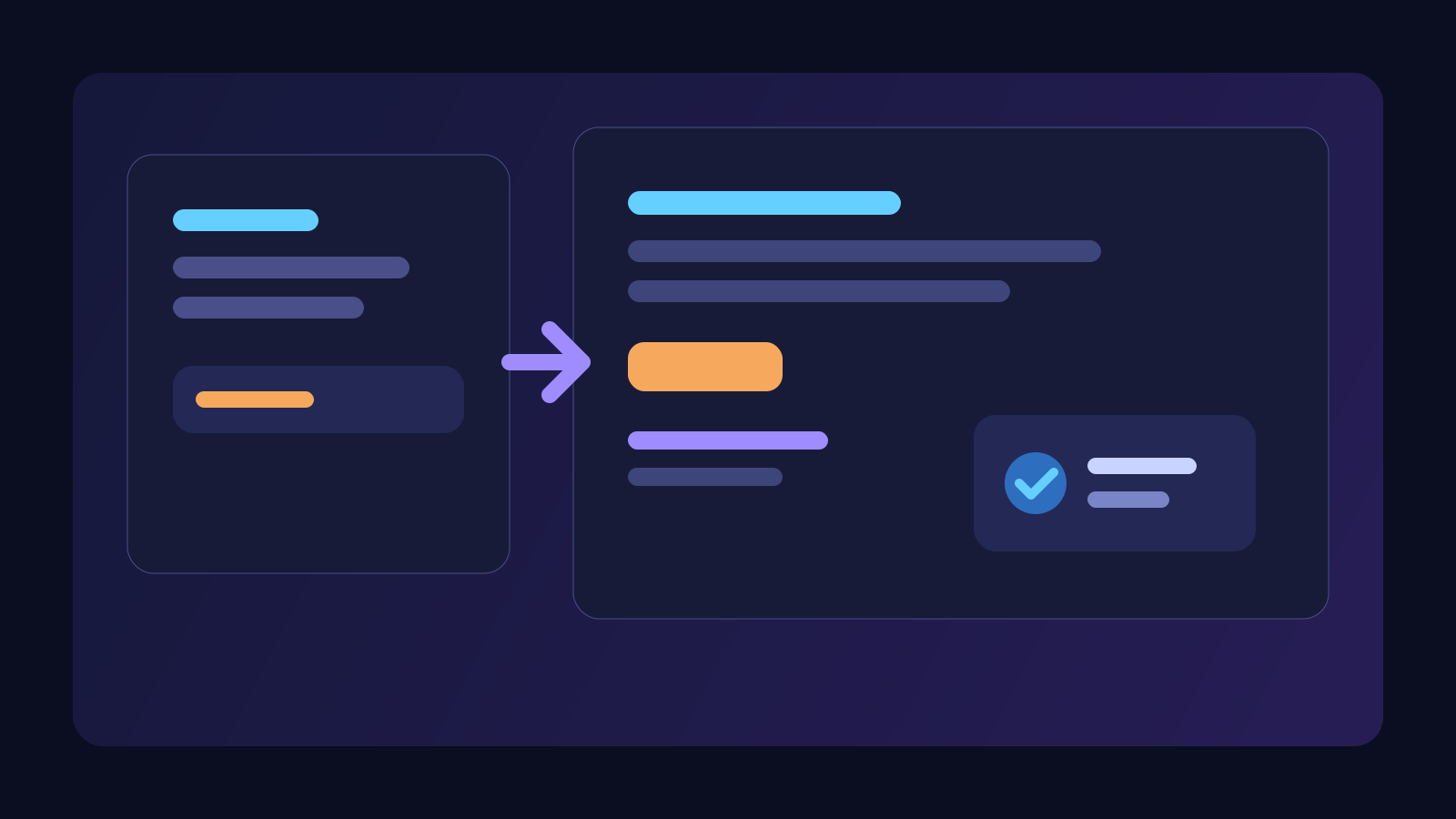
The promise that brings someone to the page should continue on the page itself.
If an ad mentions same-day website fixes, the landing page should acknowledge same-day website fixes. If the keyword is about landing page audits for service businesses, the page should not open with broad agency copy about digital growth.
Visitors need continuity.
They clicked because a specific message felt relevant. The landing page should confirm that choice quickly, not ask them to reinterpret your offer.
Why poor message match hurts conversion so quickly
Paid visitors arrive with less patience than returning visitors.
They have not built much trust yet. They are making a snap judgment. Good message match reduces the amount of mental work needed to keep moving.
Poor message match creates friction in a few predictable ways.
It makes the page feel generic
Even a polished page can feel wrong if it does not reflect the wording, angle, or offer that earned the click.
It weakens trust
When the page shifts tone or promise too sharply, people start wondering whether the ad oversold the offer.
It slows decision-making
Instead of moving toward the CTA, users scan the page to work out whether they should stay.
That hesitation shows up as bounces, shallow engagement, or form starts that never finish.
Where message match tends to break down
This usually happens in one of four places.
The headline is too broad
Many landing pages open with vague phrases about growth, performance, or results. Those lines are safe, but they often fail to echo the search term or ad angle.
The hero section drops the original context
An ad may speak to a specific pain point, like low-quality enquiries or poor mobile conversion. The page then opens with a generic description of the company.
That is a missed opportunity.
The CTA changes the commitment level
If the ad offers a quick audit and the page asks for a full consultation booking, the shift can feel premature.
The proof does not support the promise
If the page claims specialist expertise but only shows broad testimonials, the message loses force.
How to improve message match without building dozens of pages
This is where teams often overcomplicate things.
You do not need a totally unique page for every keyword variation. You do need tighter alignment between traffic source and page experience.
A few practical fixes go a long way.
Mirror the core intent in the headline
Not by awkwardly stuffing keywords, but by making the headline clearly relevant.
If the click came from a campaign about improving lead quality, say that early. If it came from a search about landing page design for legal firms, reflect that context.
Reinforce the click reason in the first screen
The hero section should answer three questions fast.
When that answer is clear, people settle in.
Keep the offer consistent
The CTA, form, and next step should match the level of intent implied by the ad. Cold traffic may respond better to a lighter commitment than a full sales call.
Use proof that feels specific
Testimonials, case study snippets, stats, and examples should support the exact promise on the page. Specific proof tightens message match more than clever copy ever will.
A simple framework for checking message match
Before launching a campaign, review the path in this order.
1. Query or ad
What exact promise, pain point, or offer earned the click?
2. Headline
Does the first line on the page clearly continue that promise?
3. Supporting copy
Does the page explain the problem in the same language the visitor likely had in mind?
4. Proof
Do testimonials, examples, or results support this exact angle?
5. CTA
Is the next step consistent with the visitor's level of intent?
That five-point check catches a lot of costly disconnects.
What strong message match looks like in practice
Imagine a service business runs an ad around “reduce form abandonment on your website.”
A weak landing page might say:
Grow your business with smarter digital experiences.
That is not wrong. It is just soft.
A stronger page might say:
Reduce form abandonment and turn more website visits into qualified enquiries.
Now the visitor feels continuity. The conversation keeps moving.
The rest of the page can then back that claim up with friction audits, mobile form fixes, call-to-action testing, and proof from similar projects.
Message match is not just a paid media issue
It also matters for organic search, email campaigns, local landing pages, and referral traffic. Anywhere someone clicks with a clear expectation, the page needs to honour that expectation quickly.
That is why message match sits right at the intersection of copy, UX, and CRO.
It is not just a headline exercise. It is a trust exercise.
Small changes here can make campaigns feel much more efficient
Sometimes the media buying is fine. The offer is fine. The traffic is fine.
The leak is in the handoff.
When the landing page continues the same conversation the ad started, visitors do less interpretive work. They feel more certain. They move faster.
That is what good landing page design often comes down to. Not more cleverness. More continuity.
And if your paid traffic has been expensive but strangely flat, this is one of the first places I would look.
Turn this article into a real benchmark
Start with the free Website Grader for an instant score, then move to the full AI scan when you want page-level recommendations.
Open the Free Website Grader →