The Zero-Waste Website Redesign: Planning for Efficiency and ROI in 2026
Why traditional website redesigns fail and how to use a data-first, 'zero-waste' framework to ensure your next site performs from day one.
Free tool
Grade your website before you keep reading
Most readers want a quick benchmark first. Start with the free Website Grader, then come back to this article with a clearer sense of what to fix.
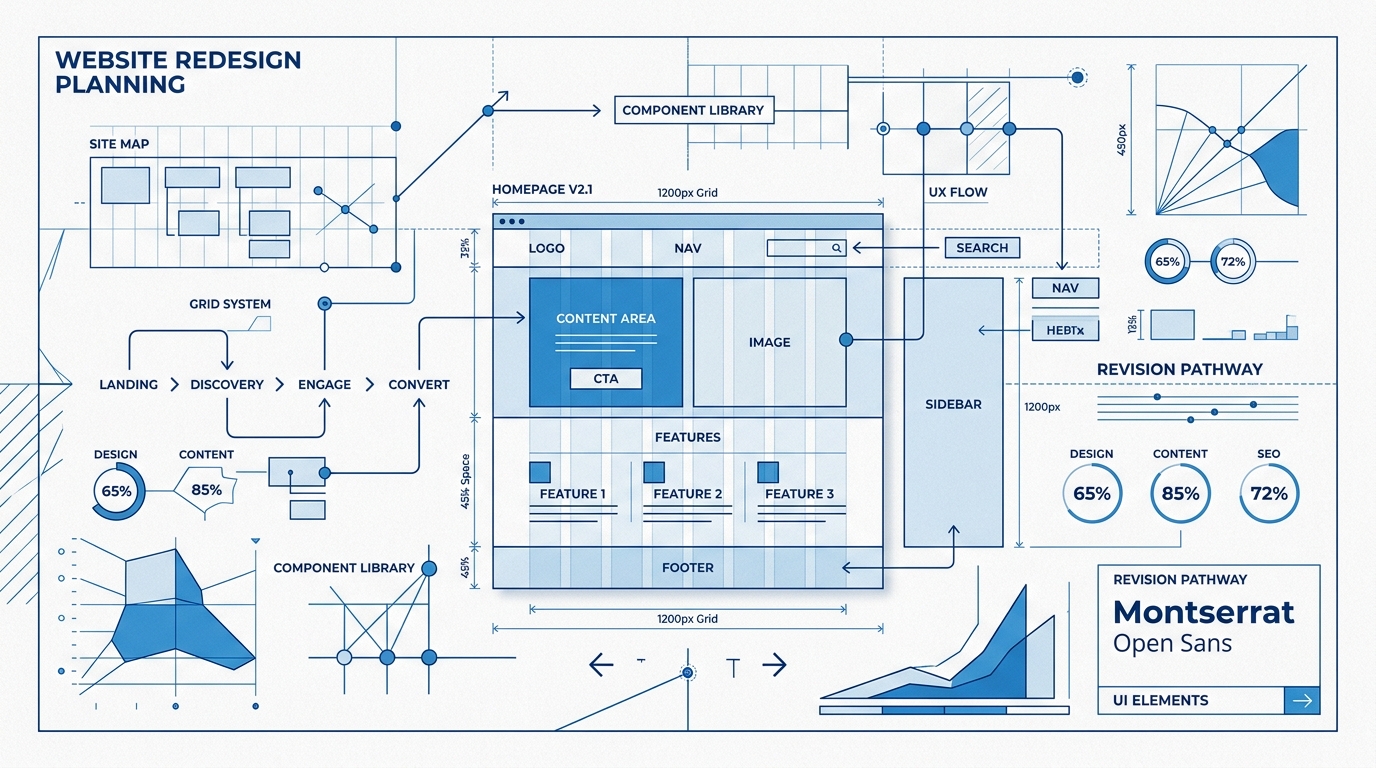
In 2026, the traditional "spray and pray" website redesign is dead. Businesses no longer have the luxury of spending six months and tens of thousands of dollars on a "visual refresh" that doesn't move the needle on conversions or search visibility.
The most successful brands have shifted to a **Zero-Waste Redesign Framework**. This approach treats your website not as a digital brochure, but as a high-performance engine that requires precision engineering.
The Problem with Traditional Redesigns
Most redesigns follow a flawed path:
The Zero-Waste Framework
To avoid these pitfalls, your 2026 redesign planning should focus on three core pillars:
1. Evidence-Based Architecture
Before a single pixel is drawn, you must understand your current baseline. Use AI-driven heatmaps and session recordings to identify where users are dropping off. A zero-waste redesign doesn't change what is already working; it surgically fixes what isn't.
2. Narrative-First Design
In the age of Agentic Search (AEO), your content structure is more important than your color palette. Your redesign should be built around "Semantic Clusters"—content that clearly explains your value proposition to both humans and AI agents. If an AI can't summarize your homepage in three seconds, your redesign is failing.
3. Performance-Ready Infrastructure
Speed is no longer a "nice-to-have." With the rise of the Agentic Web, your site needs to be readable by machines at lightning speed. This means clean code, optimized API endpoints, and a "Zero-JS" mindset for critical path elements.
The Redesign Checklist for 2026
* **Audit for AEO:** Does your new site structure support AI-driven discovery?
* **Mobile-Touch Optimization:** Is every interaction designed for the "Thumb Zone"?
* **Accessibility as Standard:** Are you meeting WCAG 2.2 Level AA from the first wireframe?
* **Trust Signal Integration:** Are reviews, case studies, and security badges woven into the conversion flow, not just buried on a footer?
Final Thought
A website redesign in 2026 isn't a project; it's the start of a continuous optimization cycle. By planning with a zero-waste mindset, you ensure that every dollar spent on design and development translates directly into business value.
Need help mapping out your next move? SiteInsight AI provides the data-backed clarity you need to design for performance.
Turn this article into a real benchmark
Start with the free Website Grader for an instant score, then move to the full AI scan when you want page-level recommendations.
Open the Free Website Grader →