Semantic Content Clusters: The Future of AI Search Strategy
Keyword density is dead. Long live semantic relevance.
Free tool
Grade your website before you keep reading
Most readers want a quick benchmark first. Start with the free Website Grader, then come back to this article with a clearer sense of what to fix.
# Semantic Content Clusters: The Future of AI Search Strategy
Keyword density is dead. Long live semantic relevance.
As we move deeper into 2026, SEO as we once knew it—a game of matching search queries with specific pages—has been replaced by **Generative Search Optimization (GSO)**. AI search agents like OpenAI's SearchGPT and Google's Gemini Search aren't just scanning your site for a single keyword; they are building a mental model of your site's entire expertise.
To rank in this environment, you need **Semantic Content Clusters**.
What is a Semantic Content Cluster?
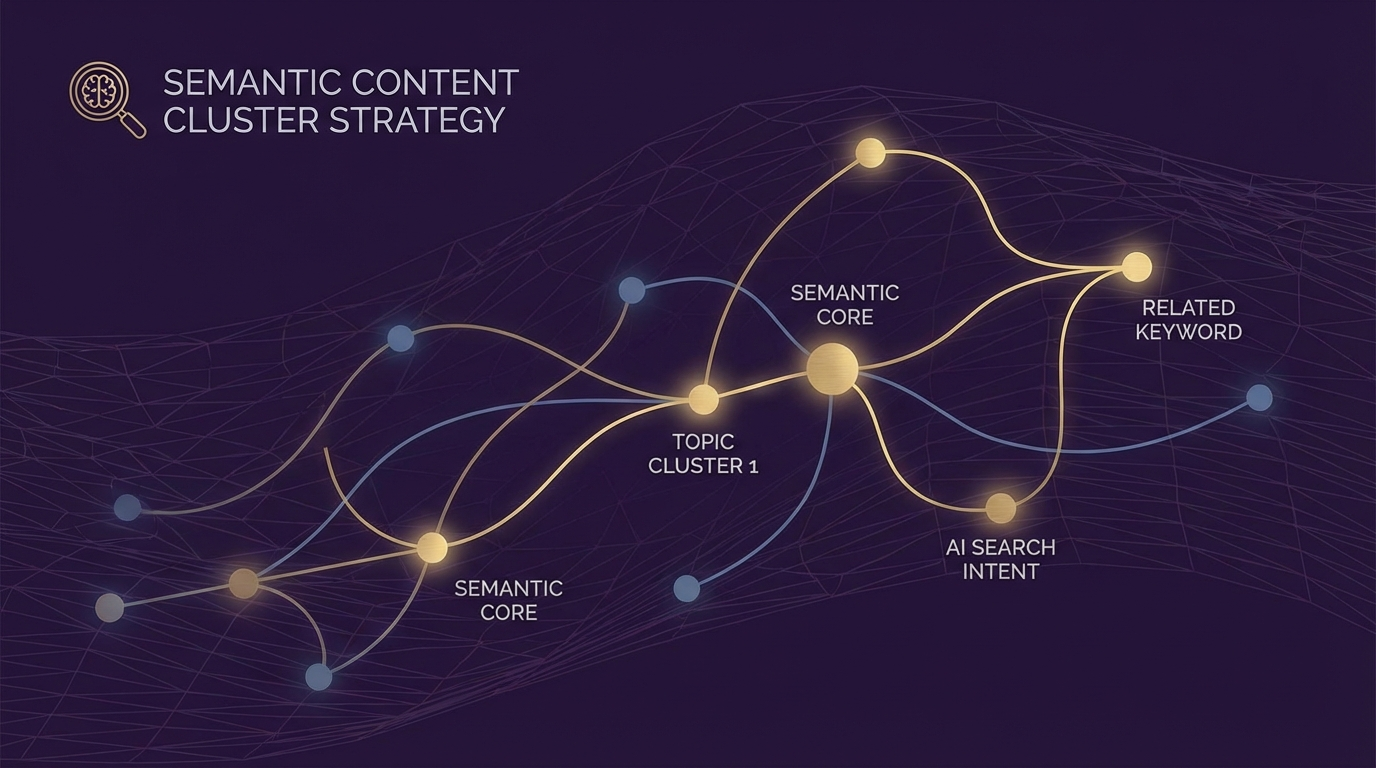
A semantic content cluster is a group of interconnected content pieces that cover a specific topic in exhaustive depth. It's not just about a main "pillar" page and some sub-topic "cluster" pages. It's about a **web of meaning**.
In the past, you might have ranked for "best cloud storage" by having that exact phrase on your page. Today, AI search engines evaluate your site based on whether you've covered:
* Data encryption (security)
* Latency across regions (performance)
* Pricing models for scaling (business impact)
* Integration with legacy systems (compatibility)
If you've covered all these semantic sub-topics, the AI search engine views your site as an "authoritative entity" for the broader topic of cloud storage.
Why AI Search Engines Prefer Clusters
AI search models (Large Language Models) are trained on massive datasets and have a deep understanding of how concepts relate to each other. When a user asks a complex question, the AI doesn't want to just give them one link; it wants to synthesize an answer.
If your content is structured as a semantic cluster, it provides the AI with:
How to Build a Semantic Cluster for 2026
1. Identify the "Core Entity"
Instead of a "target keyword," identify a "core entity"—a broad concept you want to own. For example, "Sustainable Web Design."
2. Map the Semantic Neighborhood
What are the concepts related to "Sustainable Web Design"? Carbon footprint, energy-efficient hosting, minimal code, green UX, and long-term maintainability. These are your cluster topics.
3. Create Content with Inter-Connectivity
Each piece of content in your cluster should reference and link to others within the same cluster. This creates a strong "semantic signal" that the AI search models can easily follow.
4. Use Schema Markup for Entities
Don't just write text; use JSON-LD schema to explicitly define the entities and relationships in your content. Tell the search engine, "This article is about [Sustainable Web Design] and it mentions [Green Hosting]."
Measuring Success: Moving Beyond Rankings
In the age of AI search, "position 1" in traditional results is no longer the only metric. You should be looking at:
* **AI Citation Rate:** How often is your content cited as a source in AI-generated answers?
* **Topic Share of Voice:** When an AI search agent synthesizes an answer for a broad topic, what percentage of the information comes from your site?
* **Conversion from AI Referrals:** Are the users coming from AI search agents actually high-intent leads?
Conclusion
The shift toward semantic content clusters is a move toward quality, depth, and genuine expertise. In 2026, you can't trick the algorithm with keyword stuffing. You have to earn your authority by providing a comprehensive, interconnected web of meaning.
🌌✨🔮
Turn this article into a real benchmark
Start with the free Website Grader for an instant score, then move to the full AI scan when you want page-level recommendations.
Open the Free Website Grader →