Beyond the Click: Optimizing for AI Referral Traffic and Zero-Visit Visibility in 2026
Discover how to track AI referral traffic and optimize your content for zero-visit visibility in the age of agentic search.
Free tool
Grade your website before you keep reading
Most readers want a quick benchmark first. Start with the free Website Grader, then come back to this article with a clearer sense of what to fix.
# Beyond the Click: Optimizing for AI Referral Traffic and Zero-Visit Visibility in 2026
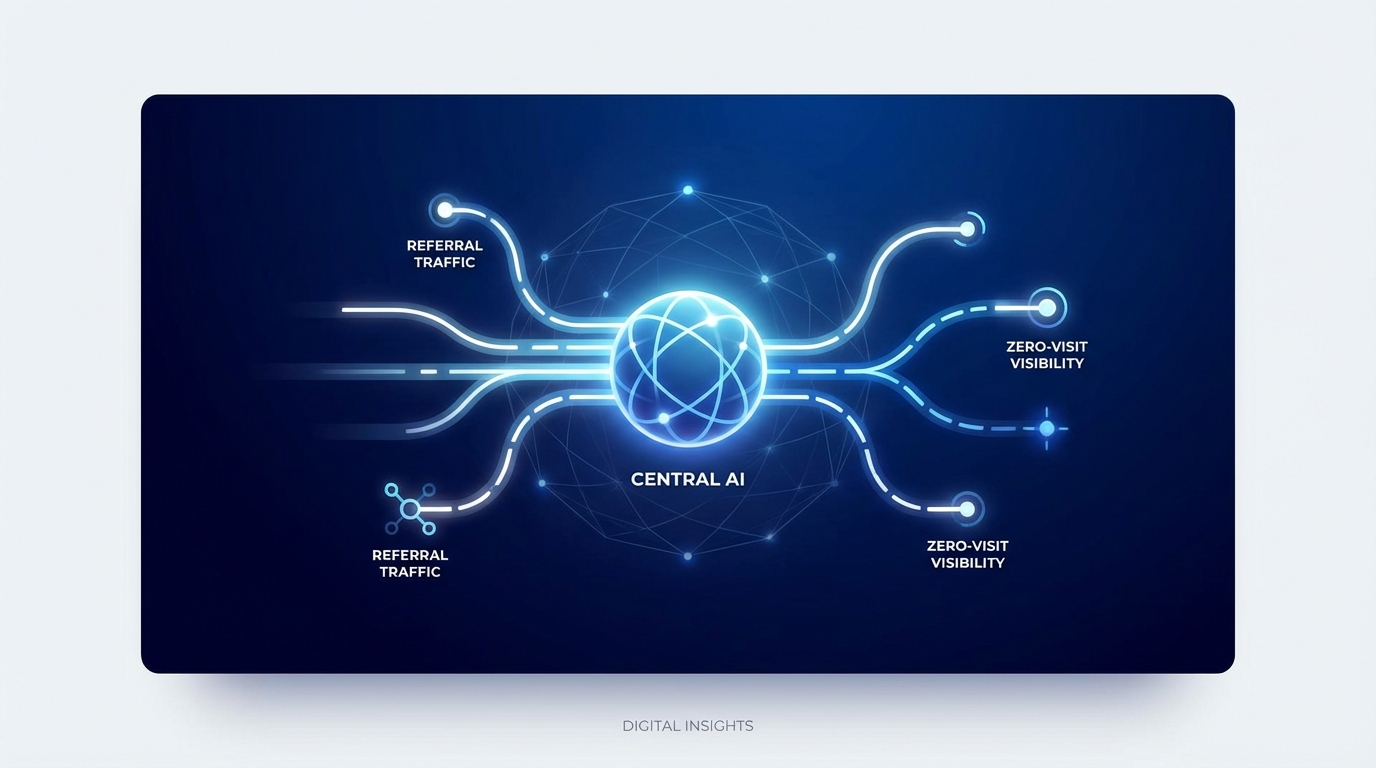
The landscape of digital discovery has undergone a seismic shift. In 2026, the traditional metric of success—the click-through—is no longer the sole arbiter of value. We have entered the era of **Zero-Visit Visibility**, where AI agents and Large Language Models (LLMs) act as the primary interface between users and information.
For businesses, this means that your content's success is increasingly determined by its ability to be synthesized, cited, and recommended by AI, rather than just its rank on a search results page.
The Rise of the AI Referral
In previous years, we tracked organic traffic, social referrals, and direct hits. Today, a new category dominates the analytics dashboard: **AI Referral Traffic**. This represents traffic originating from platforms like ChatGPT, Claude, Perplexity, and specialized industry AI agents.
Unlike traditional search engines that direct users to a URL, these platforms often provide the answer directly. When a user *does* click through, they arrive with a higher degree of intent and a baseline understanding of your brand established by the AI's summary. It's a "warm" lead in every sense of the word.
How to Track AI Referrals
Tracking this traffic requires a shift in technical implementation. AI agents often strip traditional UTM parameters or present as generic "Direct" or "Referral" traffic. To accurately measure your AI footprint, you must:
Information Gain: The New SEO Gold Standard
When everyone can generate 2,000 words of generic content with a single prompt, "volume" becomes mere noise. In 2026, AI algorithms prioritize **Information Gain**—the delta between what is already known in their training set and the unique, first-hand insights your content provides.
To win in an AI-saturated landscape, your content must offer:
* **Primary Data:** Original research, surveys, and case studies that aren't yet in the public domain.
* **Expert Synthesis:** Connecting disparate dots in a way that generic LLMs cannot replicate without human nuance.
* **Opinion and Edge:** AI is trained to be neutral. Human-led content that takes a stand or offers a unique perspective provides the "flavor" that users (and AI agents) crave for a complete answer.
Want a fast score before you touch the site?
Use the free Website Grader to get an instant trust, UX, SEO, and performance score, then decide if you need the full AI review.
Open the Free Website Grader →Structuring for Synthesis
If an AI cannot parse your content, it cannot cite it. Structuring for AI interpretation is as much about clarity as it is about code.
Schema Markup v3.0
Beyond standard Breadcrumbs and Article schema, 2026 demands more granular data. Implement `KnowledgeGraph` and `CitationSource` schemas to help AI agents understand the lineage of your facts. Use `ClaimReview` for any statistical assertions to build trust with automated fact-checkers.
The "Summary-First" Architecture
Users and AI agents alike prefer a hierarchical structure. Every article should lead with an **AI-Optimized TL;DR**—a 200-word summary that encapsulates the core findings. This isn't just for the human reader; it provides the LLM crawler with a clean, high-probability summary to ingest for its knowledge base.
The "Human-Made" Premium
As the internet becomes flooded with synthetic content, authenticity has become a luxury good. The "Human-Made" label is no longer just a badge of honor; it's a technical requirement for high-trust environments.
Signal, Not Noise
AI detectors have become sophisticated, but the real signal of human authorship is found in the texture of the writing:
* **First-Person Narrative:** "We found," "In my experience," "Last Tuesday, our team noticed..."
* **Conversational Nuance:** Using metaphors, cultural references, and subtle humor that reflect a living author.
* **Transparency:** Explicitly stating where AI was used as a tool (e.g., for research or brainstorming) versus where the human took the lead.
Conclusion
Optimizing for 2026 isn't about gaming a system; it's about being the most useful, authentic source of truth in a sea of automation. By embracing Zero-Visit Visibility and focusing on Information Gain, you ensure that even when a user doesn't click, your brand remains at the center of the conversation.
SiteInsight AI is here to help you navigate this transition, providing the analytics and insights needed to thrive in the age of agentic search. ✨
Turn this article into a real benchmark
Start with the free Website Grader for an instant score, then move to the full AI scan when you want page-level recommendations.
Open the Free Website Grader →