How to Build a Custom AI Support Agent for Your Website Support in 2026
The era of the "dumb" chatbot is officially over. In 2026, if your website's support interface just spits out links to help docs based on keywords, you're not just beh...
Free tool
Grade your website before you keep reading
Most readers want a quick benchmark first. Start with the free Website Grader, then come back to this article with a clearer sense of what to fix.
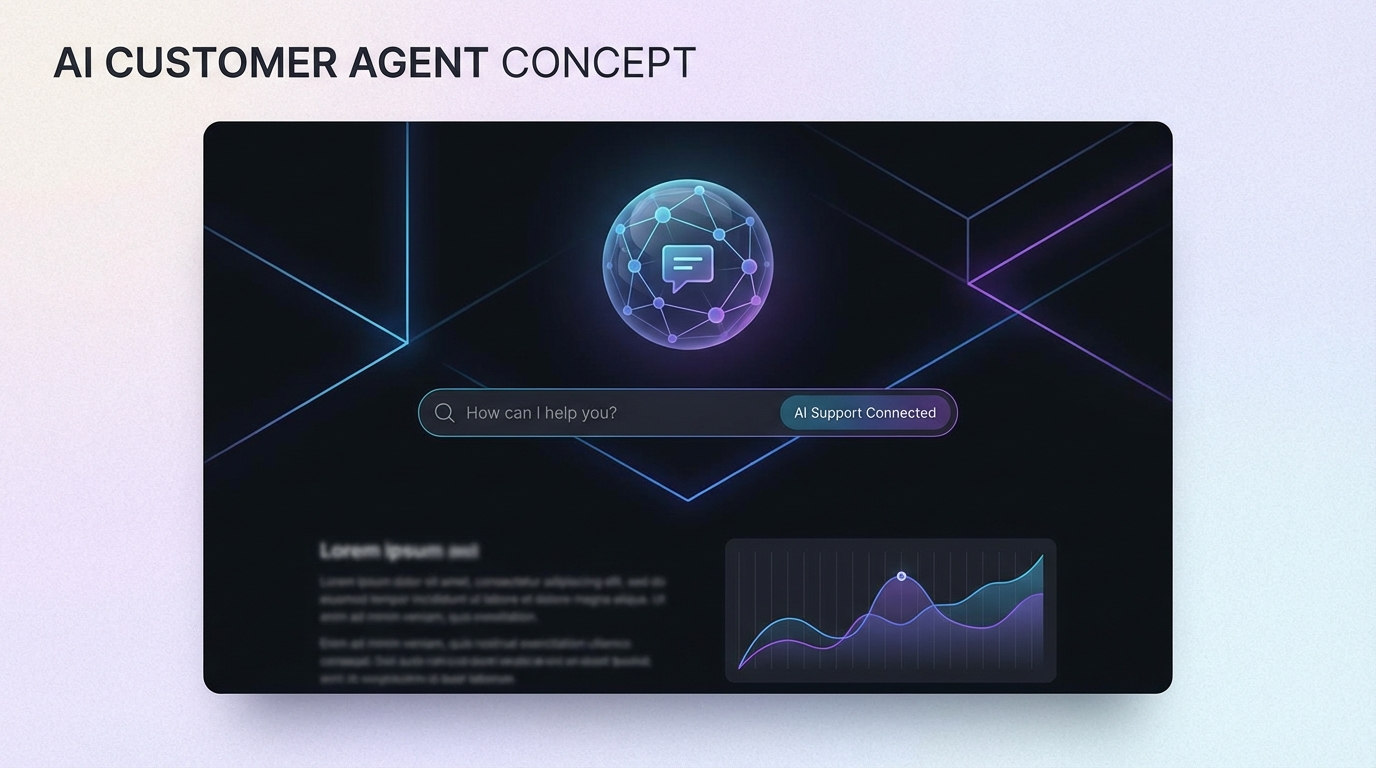
The era of the "dumb" chatbot is officially over. In 2026, if your website's support interface just spits out links to help docs based on keywords, you're not just behind—you're annoying your customers.
We've moved past simple copilots. Today, we're building autonomous agents. These aren't just scripts; they are goal-oriented systems that can reason, plan, and execute tasks. If a customer asks to "change my billing cycle to annual and apply the early-bird discount," a modern agent doesn't send a link. It verifies the user, checks the discount eligibility, updates the CRM, and sends a confirmation.
Here is how you actually build one of these things in 2026.
1. Move from keywords to intent
The biggest mistake people still make is building "if/then" logic. You shouldn't be mapping keywords; you should be mapping intent.
In 2026, we use LLMs (like GPT-5 or Claude 4) to handle the reasoning layer. Instead of programming a specific path for "refunds," you give the agent a set of tools (APIs) and a set of rules (your refund policy). The agent then decides which tool to use based on the conversation context. This is "Intent-Based Computing," and it's the only way to scale without building a massive, brittle logic tree.
2. The knowledge base is your agent's brain
Your agent is only as smart as the data it can access. But in 2026, we don't just point it at a PDF.
We use **Vector Databases** for "Long-Term Memory." This allows the agent to retrieve relevant context in milliseconds. But more importantly, you need to structure your internal knowledge. Use "Agentic-Ready" documentation: clear, modular, and semantically consistent. If your help docs are a mess of contradictory info, your agent will be too.
3. Tool use and API integration
An agent that can't *do* anything is just a search engine with a personality. To build a true support agent, you need to expose your internal systems via secure APIs.
The magic happens when the agent can chain these tools together. "I've checked your account, confirmed the item is in stock, and reserved it for you." That’s a support experience; a link to a FAQ is just homework.
4. Human-in-the-loop (HITL) is mandatory
Autonomous doesn't mean unsupervised. The best AI support systems in 2026 have a human "watchdog."
You need a dashboard where human agents can see AI-customer interactions in real-time. If the agent’s "confidence score" drops below a certain threshold—or if the customer's sentiment turns sharply negative—the human should be able to "take the wheel" instantly.
5. Deployment and the "Start Small" rule
Don't try to automate your entire support department on day one. Pick one high-volume, low-complexity intent (like "Order Status" or "Password Resets") and let your agent handle it.
Monitor the results. Are customers actually getting what they need? Is the resolution time dropping? Once that one intent is rock-solid, add another. This iterative approach is how you build trust—both for your customers and your team.
---
I genuinely think we’re at a point where the distinction between "AI" and "Human" support is starting to fade. Not because AI is becoming human, but because the tools are finally becoming useful enough that the customer doesn't care who (or what) solved their problem. They just want it solved.
If you’re still using a chatbot that starts every message with "I'm sorry, I didn't quite get that," it’s time to rebuild. 🌌✨
Turn this article into a real benchmark
Start with the free Website Grader for an instant score, then move to the full AI scan when you want page-level recommendations.
Open the Free Website Grader →